

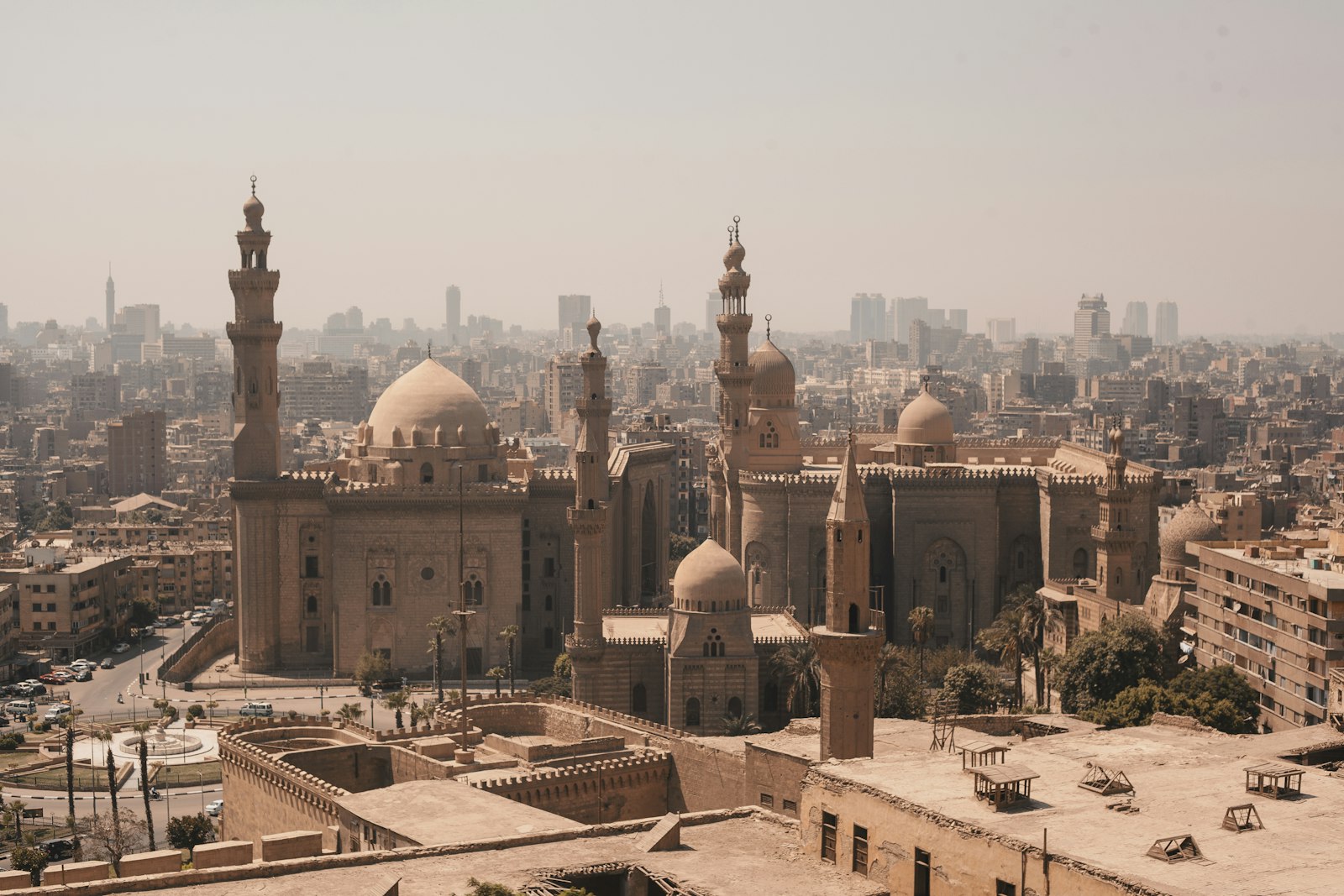
While most first-time visitors spend their Cairo time at Giza and the Egyptian Museum, the historic district generally called Islamic Cairo — centred on Khan el-Khalili — is where the city's medieval character is still fully intact: narrow alleys, centuries-old mosques, and a bazaar that has been trading continuously since the 14th century.
Getting oriented
The district sits east of downtown Cairo and is easiest to reach by taxi or ride-hailing app, since it's a dense, largely pedestrian area not well suited to driving yourself. Most visitors treat it as a half-day or full-day walking route rather than a single stop, combining the historic mosques with the bazaar itself and a stop for food or tea along the way.
Al-Azhar Mosque and the historic core
Al-Azhar Mosque, founded in 970 AD and still an active center of Islamic learning, anchors the district and is open to respectful visitors outside of prayer times. Nearby, the Sultan Hassan and Al-Rifa'i mosques — both a short taxi ride south, near the Citadel — are worth the detour for their scale and architecture even for travelers who aren't planning to explore mosque architecture in depth elsewhere in the country.
Khan el-Khalili bazaar
The bazaar itself is a genuine working market, not a recreation — a maze of narrow lanes selling spices, brassware, textiles, jewellery, glass lamps, perfume oils, and souvenirs, organized loosely by trade the way medieval markets often were. Expect it to be busy, a little chaotic, and genuinely enjoyable to wander without a fixed plan for an hour or two.
Bargaining and shopping tips
Prices in the bazaar are rarely fixed, and haggling is a normal, expected part of buying anything beyond a fixed-price shop. A friendly, unhurried back-and-forth is the norm rather than an aggressive negotiation — starting around half the initial asking price and working toward a middle ground is a reasonable approach for most souvenirs. Spices, perfume oils, and small brass or copper items tend to be good value; for anything claimed to be antique or genuinely old, treat the claim with skepticism unless you know the seller or the material well.
Food stops along the way
El Fishawy, one of Cairo's oldest continuously operating coffeehouses, sits right in the heart of the bazaar and is a well-known spot for mint tea, karkade, or coffee while people-watching — it gets busy, but that's part of the experience. For food, the surrounding streets have simple grill and koshari spots well suited to a break partway through a day of walking.
Practical tips
- Wear comfortable, closed shoes — the alleys are uneven stone and can be crowded.
- Modest dress is appropriate when entering mosques; scarves are usually available to borrow at the entrance if needed.
- Keep valuables secure in the busier lanes, as you would in any crowded market anywhere in the world.
- Go later in the afternoon into the evening for the liveliest atmosphere, when the lanterns and shopfronts are lit and the area is at its busiest and most photogenic.
It's easy to spend a few hours in Khan el-Khalili without buying anything at all and still leave feeling like you've seen a different, older layer of Cairo than the one most itineraries show.